Complex adaptive systems, fractals and Gaia

This is really intended as a side-bar to draw together a few related concepts: Gaia theory, fractals, and complex adaptive systems. If you’re already familiar with all three, you may want to skip this post and go read this, instead.

Fractals


Benoît Mandelbrot famously coined the term fractal in 1975 to describe shapes or patterns which replicate at different scales, so that each part contains a representation of the whole.

It turns out lots of patterns in nature are fractal and lots of patterns in human behaviour and human organisations are also fractal.

For example, the process of project management is essentially fractal. The five main process groups for a project are defined in the Project Management Body of Knowledge (PMBoK), as:

  • Initiating
  • Planning
  • Executing
  • Monitoring and controlling
  • Closing

And projects tend to be iterative, so we can apply these five process groups to any part of the project, as well as to the whole project.

As Dr Mandelbrot points out in the video above, a cauliflower is also fractal.

This does not imply that a project is a cauliflower, or vice versa.

Gaia theory

In his 1979 book, Gaia: a new look at life on earthJames Lovelock proposed a way of thinking of the earth as a complex collection of interdependent elements working together to maintain the planet in a healthy dynamic equilibrium.

In effect, this is very similar to thinking of the earth as a single living ecosystem or organism. Just as a body has organs, sensory systems, immune systems, neurological systems, all working together to keep the body healthy, so we can think of ecosystems in the same way.

Complex adaptive systems

Emergence

Emergence from a complex system - the whole is more than the sum of its parts

The idea of a complex adaptive system (CAS) embraces some elements of Gaia theory and some elements of a fractal. The origin of the term is attributed to researchers at the Santa Fe Institute.

In it’s most basic form, if we think of a single animal or plant as a complex collection of cells, then we think of a large group of animals and plants together to form an ecosystem, we find that the single animal and the ecosystem both have quite a lot of characteristics in common – both may be described as a CAS.

Similarly, when large numbers of human beings group together to form an organisation, a market, a nation, or something bigger, that’s also a CAS.

Like fractals, people are now finding the idea of a CAS is useful to describe all sorts of natural and social phenomena, including languages, cultures, weather and galaxies.

It’s interesting to note all these theories emerged in the ’70s, within a few years of each other. Maybe this is an example of the 100th monkey phenomenon, or just an emergent property of going to rock concerts during the ’60s.

Posted in Positioning for the future, Quality, Two-way communication | Tagged , , , , , , , , , , , | 3 Comments

Two reasons to be happy

Sometimes being human can be overwhelming, especially if we care about the planet and the people on it.

So here are two reasons to be happy:

1) Action and change is happening all around you, all the time. Think about some of the progress human beings have made in the last 200 years (in some parts of the world, not all):

  • the abolition of slavery
  • votes for women
  • votes for all races
  • access to education
  • the rule of law
  • treatments for diseases like polio, whooping cough, rabies, bubonic plague
  • etc.

Three hundred years ago the whole world was run by violent dictators who maintained power from castles, armed with swords. Some of us are lucky to have moved so far from that reality. But there are still many parts of the world where people are still living in the modern equivalent of the middle ages and the one with the most guns is still in charge.

So, if you have access to a computer and can read this, be thankful for the freedoms you enjoy in the modern world and if you want to be active, work to share those freedoms with others who don’t have them yet.

2) Human beings have been talking about the end of the world for hundreds or even thousands of years.

The Vikings believed in Ragnarok, an epic final battle between Loki the trickster and the gods of Valhalla.

Christians have been predicting the ‘second coming’ or the ‘rapture’ for centuries. The Book of Revelation is believed to have been written around the end of the first century AD (ie nearly 2,000 years ago). Don’t just take my word for it, see what the Encyclopaedia Britannica has to say on the subject.

The Mayan calendar has often been touted as predicting various end dates for the world as we know it.

In the 1890s, many authors, artists and cultural leaders talked about the end of the world, as they faced the prospect of moving into a new century. Shortly afterwards they experienced the First World War, and many believed the world literally was ending.

I remember when I was at school, every few years there would be news reports about some sort of planetary alignment, or prediction from Nostradamus, that meant the world was going to end on Wednesday – but it never did.

We did it again in 1999, when the Y2K bug was supposed to bring about the end of civilisation by shutting down all our computers…

…and we’re still here and we still seem to be improving. So there’s a lot of evidence to suggest maybe the human race is pretty resilient and adaptable and we’re still learning.

In truth, ‘the world as we know it’ is destroyed every second of every day and replaced with a new world which is almost the same, but now has a new thought, a new technology, a new medical breakthrough, a new political movement, a new book, a new artistic movement, new people being born.

Be happy you’re part of it and keep doing your bit to help the evolution continue.

With love.

Posted in Positioning for the future, Quality, Two-way communication | Tagged , , , , , , , , , , | 3 Comments

Mental health part one – Open Space

Back in 2008 the Health Department hosted a day-long community consultation forum, seeking input on the following question: ‘What can we ALL do to better the mental health of ALL West Australians?’
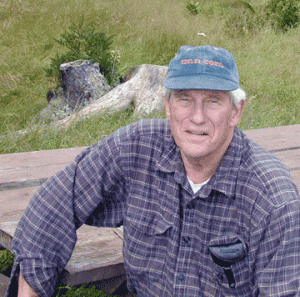
Harrison Owen - discoverer of Open Space Technology

Harrison Owen - discoverer of Open Space Technology

My interest in the event was three-fold:

  • As a communications practitioner, I wanted to observe the technical aspects – how the forum was run, what worked, what could be improved.
  • As a stakeholder, I have a keen interest in mental health. Like many of us, close friends, ex-partners, work colleagues, have had engagement with the mental health ‘system’ at one time or another. Some of those people have travelled down the dark tunnel of addiction and/or psychosis. Some of them are now dead. So I’ve had opportunities to observe those engagements and form some opinions.
  • The forum was exactly two weeks before the birth of my beautiful daughter. In the approach to parenthood, I developed a strong interest in factors contributing to strength of character and personality. We’ve all witnessed the phenomenon where two children grow up with similar parenting, similar background, similar experiences, but when they hit their teens and start to face some of life’s challenges, one learns to deal with those challenges and grows, while the other goes off the rails. I wanted to understand why this happens so I could be a better parent and help my daughter develop the resilience and coping skills she needs to tackle the challenges ahead.

The first observation from the day was the skill with which the facilitator, Brendan McKeague, used the self-organising skills of the attendees to do his job for him. Mr McKeague was using a technique known as ‘Open Space Technology’, which was invented or ‘discovered’ by Harrison Owen, when he realised the best parts of every conference are the breaks and mixers, where participants seek each other out for informal discussions.

Mr McKeague began with an observation: each person in the room cared enough about the subject to make an effort, and take time out of their schedule to attend the workshop. Each one of us had some powerful thought that motivated us to show up that day.

So the point of the exercise was to draw those thoughts out of our heads and to share them with the group.

McKeague established a number of designated spaces for conversations to take place. He established four timeslots for conversations to take place, two before lunch, two after lunch.

In the middle of the room he placed butchers paper and a microphone. On the wall was a grid where we could book a conversation space and a timeslot. To convene a conversation, we had to write the subject on a piece of butchers paper, talk briefly about our subject on the microphone, then go to the wall, book a timeslot and a space, and stick the whole lot up where everyone could see it.
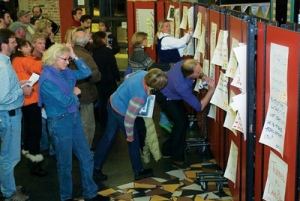
Ideas marketplace in action

Ideas marketplace in action

The wall became a ‘marketplace’ for ideas and conversations. This list of what conversations would be happening, where they would happen and when became the ‘agenda’ for the workshop. Each group was also responsible for recording the key points of the discussion and recommendations to create a ‘book of proceedings’.

Then all we had to do was decide which conversations we wanted to be part of.

The whole exercise was underpinned by the four guiding principles of Open Space:
1. whoever comes are the right people
2. whatever happens is the only thing that could have happened.
3. when it starts is the right time
4. when it’s over it’s over

and the ‘Law of Two Feet’: If at any time you find yourself in any situation where you are neither learning nor contributing: use your two feet and go someplace else.

Bearing in mind my self-appointed dual role as technical observer and participant, I could have remained detached from the proceedings, but I chose to jump in and convene a discussion because:

  • it would have been disrespectful not to match the level of passion and commitment from the other participants
  • we always learn more when we push ourselves out of our comfort zone
  • sometimes the best way to really learn how something works is to immerse in the experience and see what happens.

Pitching a conversation in the ‘idea marketplace’ was scary. I didn’t know anyone else there that day. I had no idea if anyone would be interested in my idea. What if no one showed up?

I needn’t have worried. People were interested. They roamed from space to space, observing, learning and sharing their experiences.

What amazed me was how well it worked. More than 70 conversations took place and, from what I saw, each one attracted roughly 5-20 participants.

I saw people make a real effort to engage with each other, listen to each other, respect each other, encourage and tease out dissenting views.

For me, the first wonderful insight came from Mr McKeague very early in the day. After the introductory session in the morning, where McKeague made sure we all understood the process, he left. Quite literally, he walked out and left us all to it.

As always, actions speak louder than words. McKeague’s actions very clearly communicated his confidence in the four guiding principles of Open Space. The participants were empowered to take control of the day, without any hovering authority to appeal to for guidance or support or judgement.

Open Space is just one example of ‘organisational judo’ (or, if you prefer, ‘organisational permaculture’), harnessing the power of a pre-existing trend or organising principle to achieve a result, without a lot of difficult pushing against the tide.

More on mental health: Part 1 [Part 2] [Part 3] [Part 4]

To learn more about the details of Open Space, check the links below.
http://www.openspaceworld.com – Harrison Owen’s Open Space pages
http://www.openspaceworld.org – resources for Open Space practitioners
http://uvic.commonenergy.org/wiki/Open_Space_Technology – Open Space wiki hosted by the Common Energy network
http://workforcefanatic.typepad.com/bamboo_us/2006/12/an_open_space_r.html – Open Space reading list by Michele Martin
http://en.wikipedia.org/wiki/Open_Space_Technology – nuff said


Posted in Positioning for the future, Two-way communication | Tagged , , , , , , , , , , , , , , , , | 6 Comments

Not Brad and Ange

It’s never trendy to say anything nice about Telstra, but they certainly do tell a good story. The Brad and Emma ads have divided commentators. Some people hate them. I must admit I love them, but that’s not the point of this post.

Telstra (or, more accurately, Telstra’s marketing agency BWM) has once again created characters who have been working their way into the Australian consciousness (and onto Facebook) since 2008.

They have a strong track record of doing this, notably with the BigPond broadband ads which started in 2005.

And, even though it hasn’t been strictly part of the Telstra brand for many years, ‘Not happy Jan’ from Yellow Pages in 2002 is now firmly entrenched in the Australian lexicon.

The point is, it can be very effective to find strong characters or themes to tell your story in different ways, over several campaigns and executions, and keep developing the idea over a long period of time. But very few organisations manage to do it well.

Many marketing managers on the client side are impatient and constantly wanting to create something new. Which is all well and good, but sometimes loses sight of the real point of marketing, which is to achieve results for the organisation, not to promote the ambitions of the marketing team. This is particularly noticeable when a new marketer moves into an organisation and slashes and burns all previous work to put his or her own stamp on the creative.

It’s a truism that organisations become bored with their own ads much faster than their customers do. This causes advertisers to miss some of the key advantages of TV.

Our living room is an intimate space where the television offers a window into the lives and dramas of characters we identify with and come to care about. But intimacy takes time to fully develop. And, at risk of stating the mind-numbingly obvious, repetition is one of the most powerful tools in any form of communication.

Posted in Increasing revenue, Two-way communication | Tagged , , , | Leave a comment

The ‘race’ card

The below average debate

...blah, blah, asylum seekers, blah, blah, stop the boats, blah, blah...

Election debate 2010, what a let-down. There was way more passion and heart in the Masterchef final.

Maybe it’s just a function of growing older and more aware of the strings at work behind the puppet show, but it seems as though this election is one of the most cynical we’ve had.

Even though Barack Obama is the USA’s first black president and Kevin Rudd is the whitest white guy anyone’s ever seen, they both managed to bring a sense of genuine idealism and hope back to politics at a time when voters were becoming increasingly disengaged.

This time around, it’s hard to be excited about the prospect of our first elected female PM when both contestants are so focused on winning, they only tell us what they think we want to hear.

Well, I for one do not want to hear any more about ‘stopping the boats’ in this election. It’s a non-issue.

Last year only 206 visas were granted to asylum seekers who came to Australia by boat. 206?!? Aren’t there supposed to be endless waves of boat people covering our shores like the beaches at Normandy?

In total, the Office of the United Nations High Commissioner for Refugees (UNHCR) reported only 6,510 applications for asylum in 2009 in both Australia and New Zealand combined. Hardly any of those applicants arrived in boats. The vast majority came on planes, after completing a lengthy application process in their own country.

To put that in perspective, in 2008–09, according to the Department of Immigration and Citizenship:

  • More than 171,000 migrants were granted visas under the Skill and Family Streams of Australia’s Migration Program.
  • Nearly 670,000 people received temporary entry visas to Australia to undertake specific work or business, or to entertain, play sport, have a working holiday or study.
  • 13,507 humanitarian entrants were granted visas to enable them to live in Australia to rebuild their lives, having fled persecution or suffering.
  • Meanwhile, the population of Australia is nearing 22.5 million people.

So, to summarise those figures: as a demographic category, ‘boat people’ make no statistical impact on anything at all.

The real population issue facing our country is age. If there’s any sort of population wave threatening to swamp our economy, it’s a wave of impending retirees. We actually need more young families in this country to support our GDP growth.

Unfortunately, neither of the contestants in this election are going to say what I want to hear so I, like so many others, will end up voting based on who I don’t want to be PM.

Posted in Positioning for the future, Two-way communication | Tagged , , , , , , , | 1 Comment

GenerationOne

The GenerationOne TVC is a very powerful piece of communication, a most graphic, direct, effective way of expressing exactly what’s meant when we talk about ‘the gap’ between Indigenous and non-Indigenous Australians.

GenerationOne

GenerationOne TVC - it worked on me

This is a very complicated, multi-layered issue, and I don’t know enough about the campaign or the circumstances surrounding the campaign to have a fully formed opinion, so this is just a first impression…

It seems this campaign can be traced back to 2008 when Andrew Forrest launched the Australian Employment Covenant to find 50,000 jobs for Aboriginal Australians. The GFC hitting later that year put a slight brake on activity, but now Forrest is back with support from Kerry Stokes, James Packer and Lindsay Fox. Apparently they’ve pitched in around $2 million each.

The ad itself has been shot by Cannes Caméra d’Or winning Samson and Delilah director Warwick Thornton. Nuff said.

I’m moved and impressed by the impact of the ad itself, and also by the vibrant GenerationOne website.

I also can’t help feeling this is something of an indictment on recent governments on both sides of politics who have been so conspicuously upstaged by a bunch of (admittedly rich, well connected, entrepreneurial) blokes armed with $8 million. (There is a whole other post – or possibly a PhD – to be written one day about they way committees kill creativity.)

As always with ambitious social initiatives, the question is: can this energetic start be sustained long enough to make a difference? The fact that this project has already lasted two years and the GFC is a promising sign.

If I find a way to help, I’ll mention it here.

Posted in Positioning for the future, Two-way communication | Tagged , , , , , , , | 1 Comment

McCain (not so) sweet potato superfries

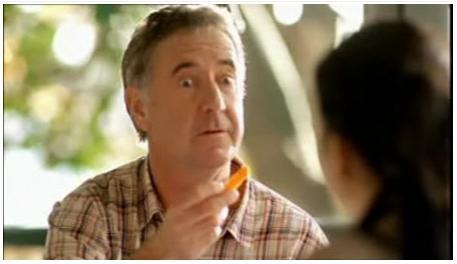
Why does the McCain sweet potato superfries ad annoy me so much, every time I see it?

First reason: if you’re thinking ‘what the hell is he on about’ that pretty much speaks for itself.

Confronting the modern sweet potato

This chip is threatening my reality

Second reason: it’s lazy. There’s a stereotypical baby boomer dad who’s stuck in his ways and doesn’t want to try anything new. Yawn. And there’s an attempt to generate some dramatic tension in the form of a feisty young daughter who won’t take no for an answer as she forces this old dinosaur to confront the modern reality of… sweet potato chips. And a long-suffering mum who rolls her eyes knowingly because she knows what’s coming, she’s been down this path so many times she doesn’t even bother saying anything any more (as have we, in a million other adverts).

Third reason: if I put a plate of food in front of someone and their response was: “What do you call these? What’s wrong with the old version? Well it had better taste just as good,” I would take my plate of food and give it to someone who’s more appreciative and less rude.

I don’t have any statistical evidence but it feels like his kind of casual, off-hand rudeness is becoming increasingly common in media. I think it’s particularly driven by American TV. For example, next time you watch your favourite US cop show, notice how many transactions take place without any exchange of please or thank you.

Posted in Increasing revenue, Two-way communication | Tagged , , , , , , | 7 Comments

Marketing orientation in government

There’s a lot of debate in the public sector about whether it’s ‘appropriate’ to adopt management techniques from the private sector. For five and a half years I encouraged various government agencies to adopt what I thought of as a ‘marketing orientation’.

What I meant by that was: try to behave as though you care about what your customers think.

The relationship with the customer is possibly the most fundamental difference between the public, private and not-for-profit sectors.

In the private sector customers = revenue. We compete to acquire them, we compete to hang on to them. Customers have choices. We want them to choose us. We can never have enough customers.

In the not-for-profit sector customers are important for a different reason. NFP customers don’t really want to be customers – they would rather not have the disability, or the poverty, or the infirmity, or the lack of resources that qualifies them to be customers – but, even though they may dislike their situation, they ultimately choose the services and the support they receive. Often the organisation was created to cater for an identified need in the community. People who work in NFPs tend to be very focused on the needs of their clients. Often the funding model of the organisation is based around the number of people they help and/or the level of need of those people so, once again, customers = revenue.

This brings its own set of problems. For example, let’s say we start an NFP organisation with a vision to eliminate poverty. If we ever succeed, we lose our reason to exist and we go out of business. That’s a pretty strong incentive to not succeed. But that’s a subject for another day…

In the public sector it’s a different story. Usually the agency has at least some elements of a monopoly. In many cases the customers don’t really want to be customers, but they have no choice. For example, hands up who wants to be a customer of the tax office? Who wants to be a customer of the police? Do you really want to have to go to a government office to buy a drivers licence? Not really, but you don’t have a choice.

So the relationship with the customer is often coercive. Many government staff struggle to even think of their customers as customers. In many cases the customers seem a bit annoying, because they seem to suck up time and resources the organisation could be using to do something else. The people in the organisation might think they would be happier if they had less customers.

This attitude often shows. We all have examples of growing old waiting in a queue in an office or on a phone, for a government officer to give us appallingly bad service. We’ve all heard government staff complain that they would like to give us better service if the organisation had better funding. We all know that’s not true, because the private sector finds ways to deliver better service for less money, because otherwise they die.

I’m not suggesting the competitive market always delivers a better result. There are lots of reasons why that’s not always true. I’m suggesting it more as a thought experiment: if you’re a public servant, imagine what it would be like if your customers could choose to go somewhere else. Imagine what it would be like to have competitors. Or, just think about the last time you had to deal with another government department…

Posted in Uncategorized | Tagged , , , , , , , , , , | 1 Comment